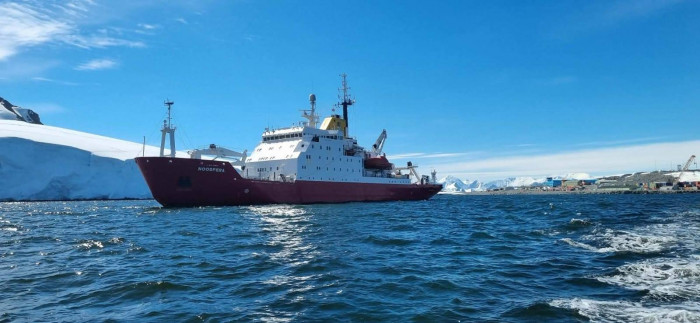
Since 11 December, the Ukrainian icebreaker Noosfera has been operating in the Antarctic Circle for the first time, facilitating international oceanographic and geological research.
The Ukrainian National Antarctic Scientific Center announced this in a statement, the CFTS portal reports.
The Vernadsky Research Base (the Ukrainian Antarctic Station), located just north of the Polar Circle, marked the starting point of the Noosfera’s route to the icy south. The Noosfera passed through the Polar Circle and Marguerite Bay on the western side of the Antarctic Peninsula and then proceeded to the British Antarctic Survey’s Rothera Research Station on Adelaide Island.
“Throughout the entire route, oceanographers searched for marine heat waves, which periodically arise because of global warming, even in the icy waters of Antarctica. To identify areas of climatic anomalies more precisely, acoustic equipment was used to map the seafloor topography,” the statement noted.
Then, scientists used a CTD (conductivity, temperature, depth) probe to measure temperature, salinity, oxygen levels, and acidity at 12 sites in the Southern Ocean, as well as to analyze chemical and biological indicators.
“In addition, Ukrainian and Mexican geologists collected seabed sediment samples, using a multi-corer, a device that presses a set of tubes into the seafloor. Their analysis will provide deeper insights into how the climate has changed over the past hundreds and thousands of years,” said the Ukrainian National Antarctic Scientific Center.
In addition to working in the ocean, the researchers visited Rothera Research Station, the largest British Antarctic base, which hosts up to 100 polar scientists in the summer and 22 in the winter. They discussed opportunities for joint research projects, which are planned to begin this season.
The Noosfera has now begun its return voyage to the Vernadsky Research Base, where scientific research will also continue.